
ABA Therapy Examples in Everyday Life
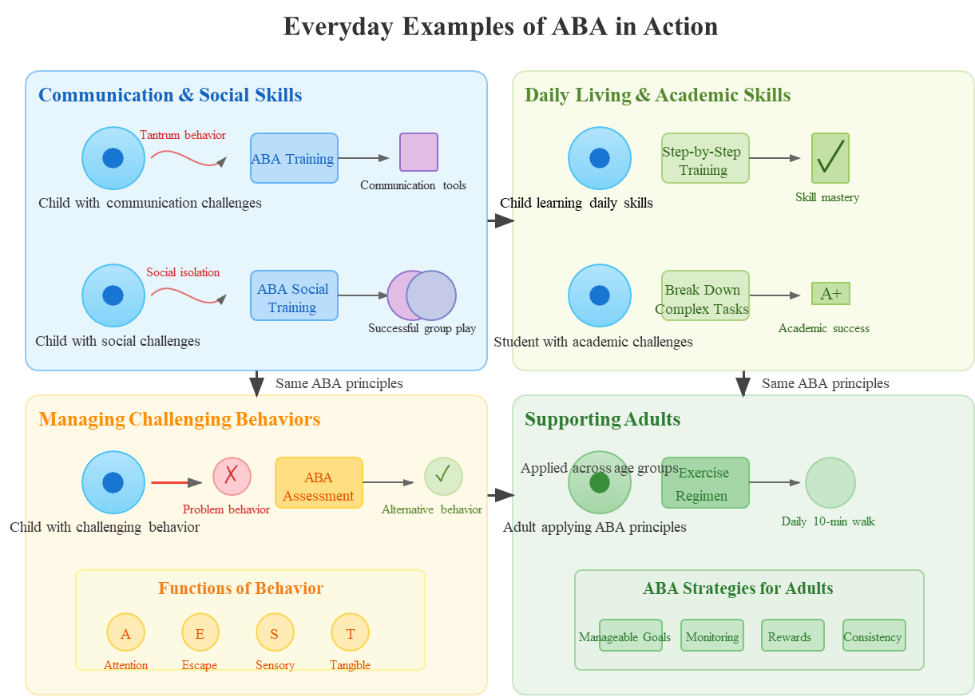
While ABA is often associated with autism therapy, its strategies apply to daily life for anyone trying to learn or change behavior. Here are relatable ABA therapy examples:
- Improving Communication
A child that has trouble getting help may instead have tantrums. ABA therapists train the child to use a simple word, sign, or picture card to request what they want. Each successful attempt is reinforced. Eventually, the child learns that communication, not tantrums, works to get their needs satisfied. Families commonly report that frustration decreases dramatically once their child learns even basic ways to express themselves.
- Building Social Skills
A young student may want to make friends but doesn’t know how to join a group at playtime. ABA breaks down the process: making eye contact, walking over, saying “Can I play?”, and waiting for a response. Every single stage is rehearsed and strengthened. The kid acquires not only companions for games but also develops the ability to be assertive in handling social encounters.
- Daily Living Skills
In ABA therapy, tasks like brushing teeth, using a utensil, and morning preparation for school are the usual targets to be worked on. These skills are imparted slowly, and with prompts and rewards given throughout the process. Parents celebrate milestones like their kid independently packing a school bag or brushing teeth without prompts—small victories that mean more independence.
- Managing Challenging Behaviors
At times kids can adopt some negative or harmful behavior—like hitting, running away, or disobeying commands—behaviors. ABA, instead of punishing such behaviors, looks through the layers and identifies the reason for the behavior (attention-seeking, task-avoiding, or sensory distress) and then teaches the child a better and safer alternate behavior. For instance, a child who hits as a way to avoid homework might be taught to ask for a little time out, thus reducing the stress for both the parents and the child.
- Academic Success
ABA helps students in school with their organization, attention, and acquiring new academic skills. For instance, if a pupil struggles with math homework, the issue can be split up into small parts that are more manageable, and each step taken can be followed by positive reinforcement. Through this process, students not only gain confidence and academic success but also motivation to undertake new challenges.
- Supporting Adults, Too
Though primarily associated with kids, ABA is also applicable to adults. It can be applied in various situations such as the workplace, independent living, or even health objectives.
Example: A grown-up wanting to make a habit of exercising can use ABA strategies—breaking down the process into simple goals (10-minute walk every day), tracking progress, and reinforcing success (listening to the favorite podcast while walking).
Limitations of ABA
ABA has a solid foundation in research and has proven to be effective in helping many people acquire skills that are meaningful to them; however, it is necessary to discuss some of the critique and limitations that are ever-present voiced by practitioners, clients, and families. The most common issue is the intensity of the traditional ABA programs that demand the client to give several hours per week, which may feel demanding and less flexible if not adjusted to the person’s needs. Moreover, they insist that ABA should be tailored to the individual needs—treating everyone the same can result in poor outcomes or even doing more harm than good. Consequently, contemporary ABA strongly focuses on strategies that are led by the child, decreased intensity when suitable, teaching in a natural setting, and giving priority to the person’s comfort, freedom, and likes. When these considerations are taken into account, it is guaranteed that ABA will be delivered in an ethical, respectful, and supportive manner that acknowledges and fosters the individual’s long-term happiness.
Why ABA Works
ABA is effective because it is:
- Individualized: No two people have the same plan; everything is tailored.
- Evidence-Based: Backed by decades of scientific research.
- Practical: Focused on real-world skills that improve quality of life.
- Collaborative: Involves parents, teachers, and caregivers for consistency.
- Flexible: Adaptable across ages, abilities, and environments.
Final Thoughts
ABA is not only a therapy but a method of helping individuals to realize their full potential. Families seeking evidence-based autism support frequently find that ABA therapy results in receiving meaningful and long-lasting progress. Incrementally building up skills, reinforcing the progress made, and teaching in a systematic yet friendly manner, ABA empowers people to talk, to live more autonomously, and to be successful in schools, social life, and daily living. It might be a child learning to brush his teeth, a student finding out how to make friends, or an adult forming good habits, ABA clearly shows that this process of transformation—step by step, behavior by behavior—can be very worthwhile.
Considering ABA therapy for your child or loved one? Remember that patience and time are essential for progress. Nevertheless, every minor victory becomes a level of independence and better life quality. If you suspect ABA could be beneficial, then a licensed Board-Certified Behavior Analyst (BCBA) should be consulted. A professional with the right qualifications will be able to evaluate the specific requirements, talk about the suitable objectives, and decide if the ABA is the right choice for your family’s path. One way to locate such a professional is by searching ‘an ABA therapy near me’.