
Applied Behavior Analysis (ABA) is widely acknowledged as one of the most effective and recognized behavior management strategies for the support of individuals having developmental, behavioral, and learning differences. ABA typically comes up first as a result of the application of evidence-based autism therapy, but the principles of ABA are much broader and can be applied in many areas of daily life. At its essence, ABA is about the study of behavior, why it occurs, and how to shape it in rich, positive ways. By breaking complex skills into smaller steps, rewarding progress, and building on strengths, ABA helps individuals learn new skills, reduce challenges, and live more independently.
This article describes what ABA is, how it works, and how it can assist an individual—backed by real-world examples that parents, caregivers, and educators can easily identify with.
What Is ABA?
ABA is a science-based way of understanding and improving human behavior. ABA is grounded in decades of research in learning theory and psychology, especially behaviorism.
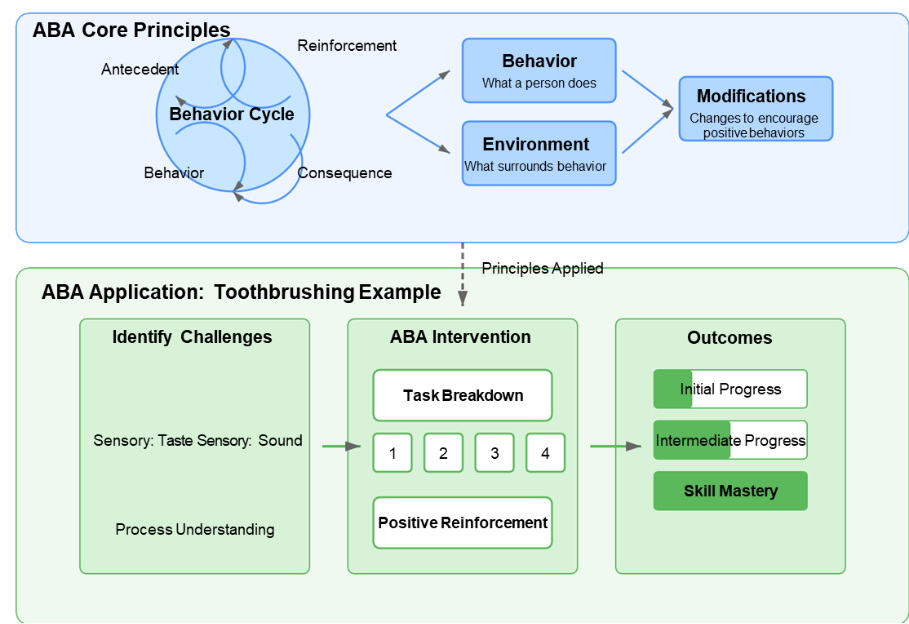
Simply put, ABA considers:
- The behavior itself (what a person does).
- The environment surrounding the behavior (what leads up to and follows it).
- How changes in the environment can encourage positive behaviors and reduce challenging ones
There are many benefits of ABA for children. For instance, consider a child who has trouble brushing his teeth. With ABA, we identify the reason why toothbrushing is hard for him: Is the child sensitive to the flavor of toothpaste? Does he get overwhelmed by the noise of the running water? Or doesn’t he understand the step-by-step process? After we know these things, we can divide up the task into baby steps and reinforce the little advances until the child masters the whole skill.
How ABA Works
ABA is based on a systematic yet flexible process. The most important behavior intervention strategies in ABA are the following:
- Goal-Setting and Assessment
All ABA journeys start with an assessment. A Board Certified Behavior Analyst (BCBA) assesses the individual’s strengths, challenges, and daily needs. Goals are then customized—such as enhancing communication, establishing social skills, strengthening self-care, or eliminating interfering behaviors that interfere with learning or relationships.
Example: If a child has difficulty sharing toys with siblings, the goal might be “engage in cooperative play for five minutes.”
- Breaking Skills into Small Steps
Large skills are broken down into small steps. This strategy, called task analysis, makes learning seem attainable.
Example: Getting dressed may be broken into:
- Picking out clothes.
- Putting on a shirt.
- Pulling up pants.
- Putting on socks.
- Zipping a jacket.
By doing each step separately and reinforcing success, the child finally does learn to get dressed by himself.
- Reinforcement (Positive Encouragement)
ABA places a strong emphasis on positive reinforcement. When a desired behavior occurs, it is followed by something pleasant—praise, getting to play with a special toy, a high-five, or even more playtime. Eventually, this results in reinforcement of the behavior, making it more likely to happen again.
For instance, an adolescent saying “hi” to a classmate in a right manner might lead to a therapist’s highly enthusiastic response: “Great job saying hi!” This appreciation gives the teenager a reason to perform that action in the next conversations.
- Data-Driven Progress
ABA therapy differs from other forms of therapy in that it is founded on precise data gathering. Therapists monitor how frequently a behavior is exhibited, the speed at which a skill is learned, or how behaviors alter over time. This enables the treatment plan to be modified by actual results.
- Generalization of Skills
It’s not sufficient to master a skill in one environment. ABA ensures skills generalize—meaning they can be used in different environments and with different people.
Example: A child might initially practice asking for water with his or her therapist. Next, practice occurs with parents at home, teachers at school, and eventually peers in a cafeteria. The skill becomes really useful when it works everywhere.